
 Ever feel like your software nudges you into awkward workarounds instead of helping you get things done? That friction isn’t random, it’s a sign your tools are steering the ship. When processes, data, and customer experience matter, Custom Software Development Services give you systems that fit the way your business really runs.
Why Tailored Software Beats “Good Enough”
Your processes aren’t generic
- Pre-packaged solutions presuppose generic working processes; your company has its exceptions, approvals, edge cases, and compliance limitations that are not the same.
- Your operations, your policies, your data rules, your handoffs, your successes are coded in custom software.
Control turns into advantage
- In customized systems, you determine the roadmap, and no longer have to wait until vendor features are released.
- Integrations, access controls and data models can be modified quickly in support of new initiatives.
Cost curves change
- SaaS costs scale per seat or per feature tier.
- Custom systems often scale by usage, not headcount, reducing marginal cost as you grow.
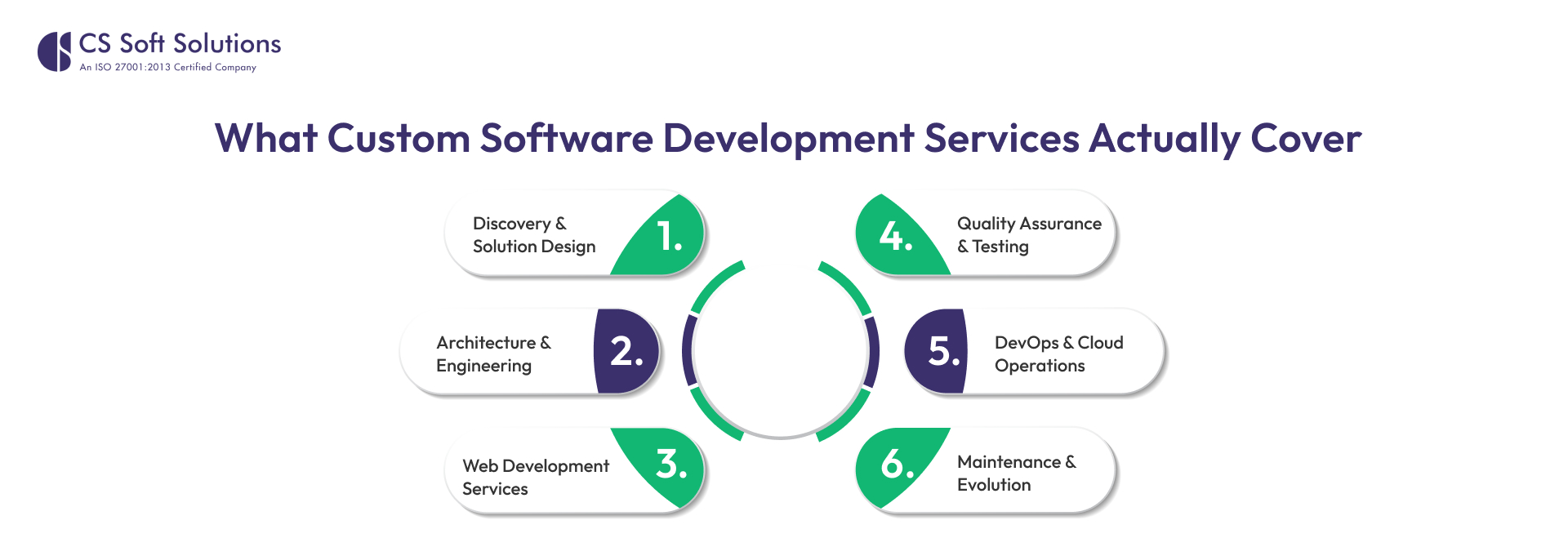
What Custom Software Development Services Actually Cover
Discovery & Solution Design
- Workflow mapping workshops, constraints and desired outcome.
- Priority models to distinguish between what must and what can be nice.
- Risk identification: compliance, data privacy, and change management.
Architecture & Engineering
- Accessible React/ Vue/ Angular front-end frameworks.
- REST/GraphQL, graphical, and conceptual design.
- Set up encrypted links with CRMs/ERP, payment companies, and logistics.
Web Development Services
- Optimised web apps and portals in response to your audiences.
- Performance budgets, caching strategies, and accessibility (WCAG).
- Robust content models of marketing teams with no bottlenecks.
Quality Assurance & Testing
- Unit/integration tests composed of software; API stability testing by contract.
- Load and stress testing containing easily understandable SLOs (latency, throughput, error rates).
- Security testing: dependency testing, secrets testing and threat testing.
DevOps & Cloud Operations
-
- CI/CD pipelines of safe release, fast release.
- Infrastructure as code (IaC) of reproducible environments.
- Observability: metrics, tracing, logs, alerting, and rollback strategies.
Maintenance & Evolution
- Continuous improvement releases based on usage analytics and feedback.
- Roadmapping aligned to business milestones.
- Documentation and training to keep teams independent.
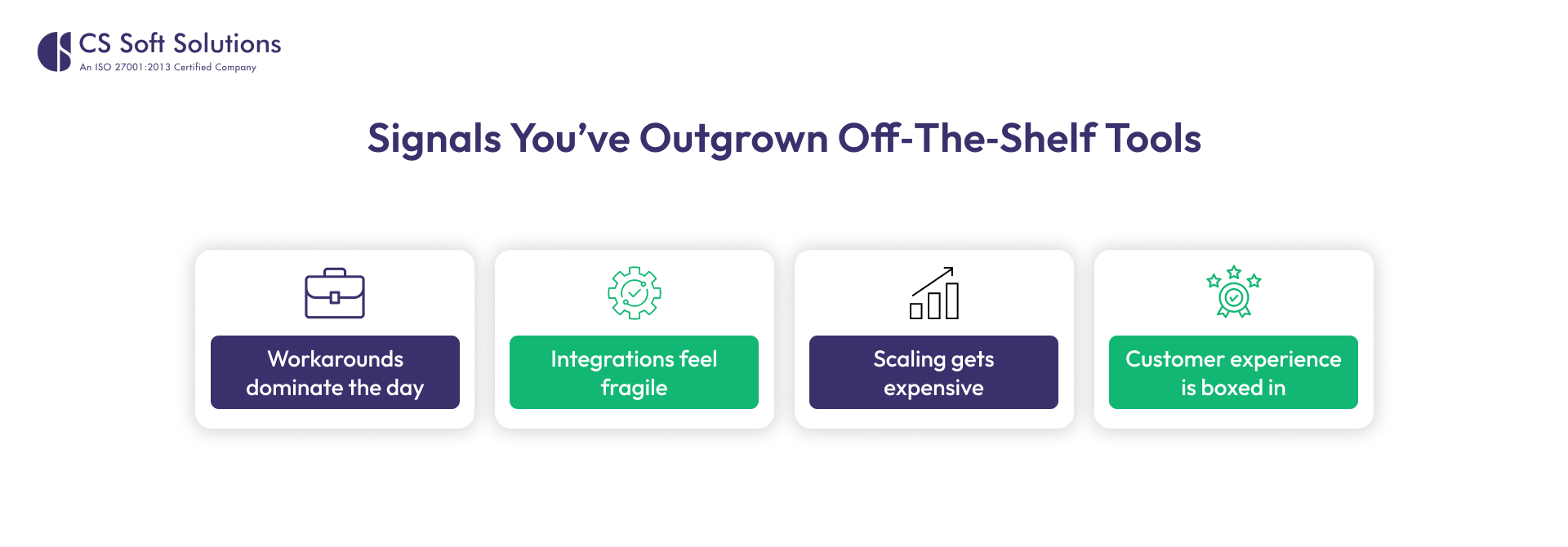
Signals You’ve Outgrown Off‑the‑Shelf Tools
Workarounds dominate the day
- Multiple exports/imports, manual reconciliations, and duplicated entries.
- Shadow systems (spreadsheets, email approvals) spring up to cover gaps.
Integrations feel fragile
- “Glue scripts” fail silently; data drift causes reporting confusion.
- Vendor APIs limit what you can automate or personalize.
Scaling gets expensive
- License tiers jump with small feature needs; per-seat models become punitive.
- Geographic or compliance expansion triggers new cost layers.
Customer experience is boxed in
- You can’t implement the flow or personalization that your strategy requires.
- The same tool your competitors use erodes differentiation.

Outcome‑Driven Benefits You Can Measure
Process Fit & Efficiency
- Fewer clicks, fewer handoffs, fewer exceptions, measurably faster cycle times.
- Embedded validations reduce downstream error correction and rework.
Data Ownership & Governance
- Custom data models reflect your business entities and relationships.
- Role-based access, audit trails, and retention policies aligned to your compliance needs.
Integration Without Duct Tape
- Cleanly connect CRM, ERP, finance, inventory, and analytics tools.
- Event streams unify systems and prevent stale data.
Predictable TCO
- Clear build and run costs, with fewer surprises from vendor lock-in or tier changes.
- Optimization paths are under your control (hosting, scaling, caching).
Differentiated UX
- Experiences that feel like your brand and match your workflow logic.
- Accessibility and performance tuned to your audience and devices.
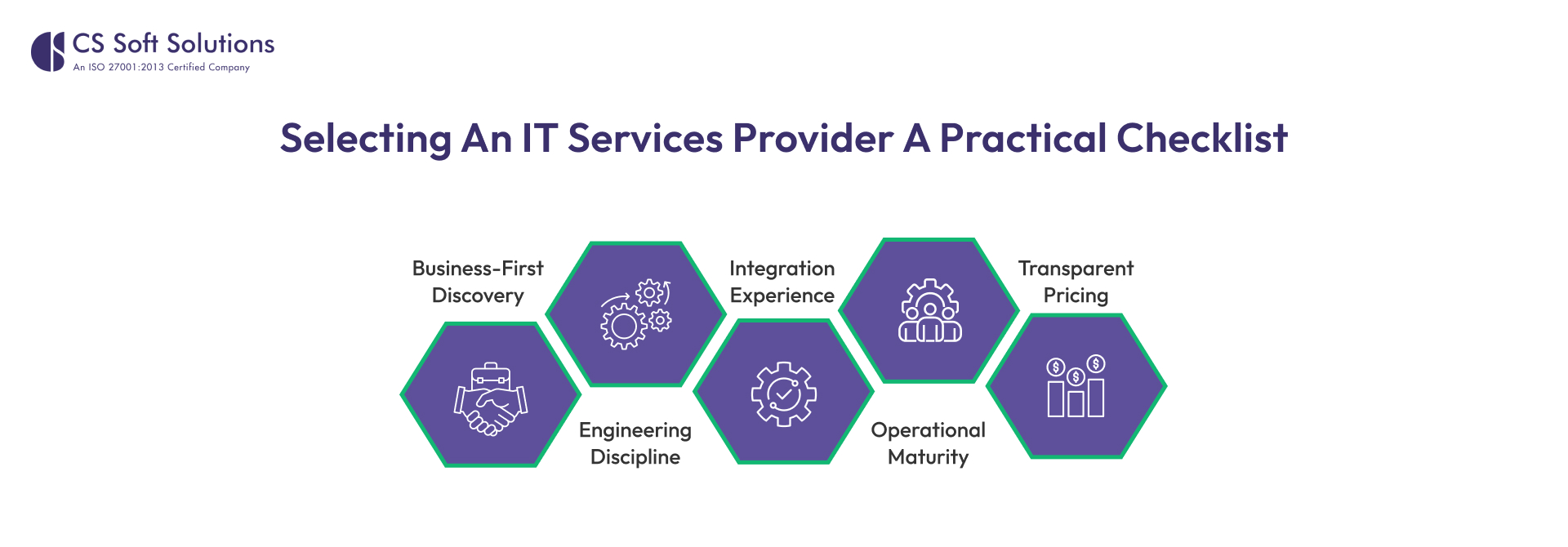
Selecting an IT Services Provider: A Practical Checklist
Business-first discovery
- Do they put goals into measurable outcomes (KPIs, SLOs)?
- Are they able to express trade-offs in understandable language?
Engineering discipline
- Transcending culture, code reviews, performance budget, and security practices.
- Types of architecture descriptions (monolith vs. microservices, serverless vs. containers), reasons.
Integration experience
- Evidence of success with your ecosystem (SAP, Salesforce, Microsoft 365, payment rails).
- Clear boundary ownership: who maintains what, and how.
Operational maturity
- CI/CD, observability, incident response, and postmortem habits.
- Documentation and handover that prevent vendor dependency.
Transparent pricing
- Milestone or outcome-based models; assumptions and change-control mechanisms.
- No black-box “fees” without context.
Where Web Development Services Fit and Where They Don’t
Perfect for the front door
- Marketing portals, partner portals, self-service flows, customer portals.
- Conversion optimization, accessibility, performance, and SEO.
But outcomes often depend on the back end
- System-of-record logic, analytics pipelines, and process automation.
- Real-time architecture and integrations.
Pairing front and back yields the win
- Web Development Services deliver the experience; custom APIs and data models deliver the substance.
Delivery Patterns That Cut Risk
- Discovery sprints (1–2 weeks)
- Map the workflow, define “done,” and capture edge cases.
- Identify measurable success metrics before writing code.
- Prototyping with clickable models
- Validate flows with real users early; reduce rework later.
- Use design systems to maintain consistency across features.
- Iterative releases (2–4 week cadence)
- Ship thin slices end-to-end; gather feedback and telemetry.
- Keep scope tight to protect quality and momentum.
- DevOps from day one
- Feature flags, safe rollbacks, automated builds/tests/deployments.
- Track (metrics/logs/traces) so problems get detected quickly.
- Security by design
- Least privilege, rest/in transit encryption, rotation of secrets, and dependency hygiene.
- Periodic drift and misconfiguration detection.
A Starter Roadmap You Can Run This Quarter
- Pick one high-friction workflow
- Intake, approvals, scheduling, pricing something with visible pain and clear stakeholders.
- Define success in 2–3 metrics (e.g., time saved, error reduction).
- Two-week discovery sprint
- Document steps, decision points, exceptions, and data touchpoints.
- Align policy/compliance requirements early.
- Prototype a thin slice
- One role’s end-to-end flow, with mock integrations where needed.
- Validate usability and correctness through short user sessions.
- Pilot with real users
- Limited scope, real data, opt-in participants.
- Gather qualitative feedback plus telemetry (completion rates, retries).
- Expand in concentric circles
- Additional roles, deeper integrations, analytics/automation layers.
- Adjust the backlog based on pilot findings.
- Operationalize
- Documentation, training, governance, and a cadence for continuous improvement.
- Ownership model: product manager, tech lead, and support processes.
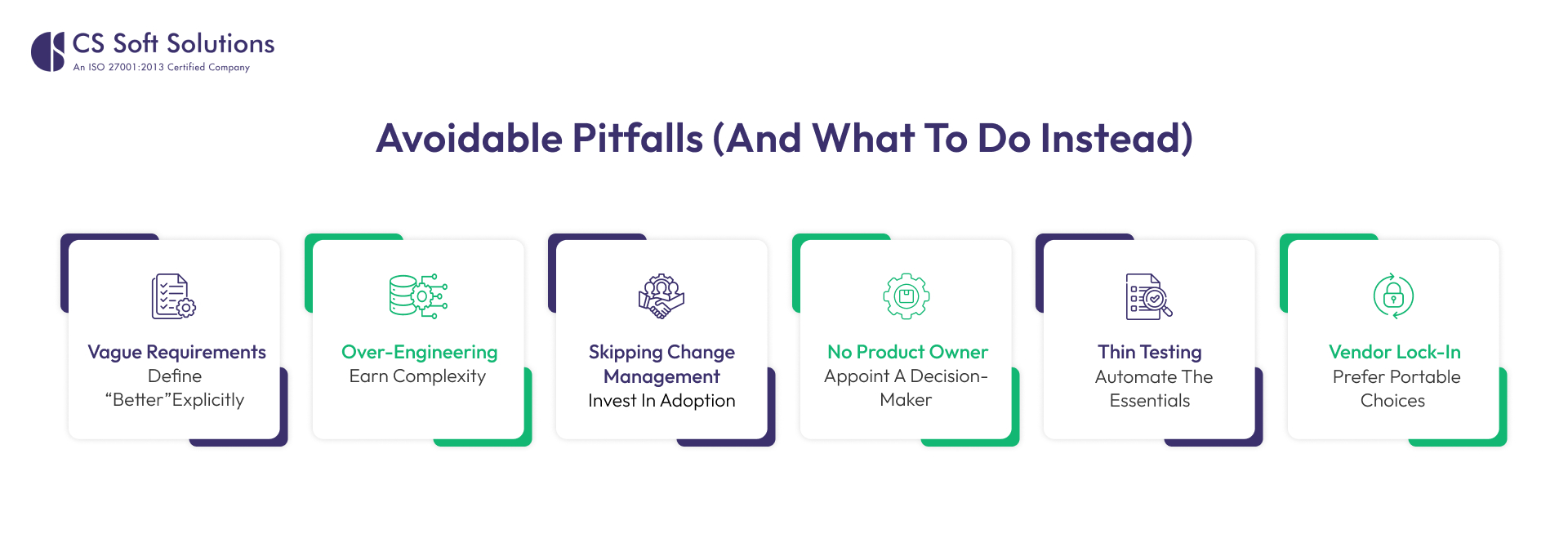
Avoidable Pitfalls (And What To Do Instead)
1. Vague requirements → Define “better” explicitly
- Replace “make it faster” with target metrics: “reduce approval cycle from 3 days to 8 hours.”
2. Over-engineering → Earn complexity
- Start simple; prioritize reliability and clarity over fancy patterns.
3. Skipping change management → Invest in adoption
- Communicate early, train well, gather feedback, iterate.
4. No product owner → Appoint a decision-maker
- Someone responsible for priorities, trade-offs, and timely approvals.
5. Thin testing → Automate the essentials
- Cover critical paths, edge cases, and performance budgets.
6. Vendor lock-in → Prefer portable choices
- Standard protocols, clear exit strategies, and documented integrations.
Wrap‑Up & Next Step
Unique processes and data are converted into a long-term competitive edge by custom software development services. Custom puts back into control over integrations, privacy, performance, and customer experience when off-the-shelf tools determine your workflow.
When you are considering the possibilities and/or you are interested in the sanity check on a sticky workflow, CS Soft Solutions India Pvt. Ltd. stands at your side to sketch a lean prototype plan that is easy to pilot, focused, and measurable.